Showing posts with label gear. Show all posts

57 signs you might be obsessed with hiking, backpacking or bushwalking.

Get teased by friends and family that you are obsessed with hiking?

Can't resist an outdoor goods sale just in case you find a new bit of gear?

Spend time at your day job dreaming of your next trip?

Don't understand why anyone would stay in a five star hotel when they could be sleeping in a tent or tarp?

Frank recently joined the forums at Trailspace.com and he stumbled across a thread titled:

You know when you are a backpacker when:


and it got him thinking that maybe HE is obsessed with the idea of the next hike or bushwalk. On continued examination he decided that being obsessed with such thoughts is a healthy pursuit and he was particularly reassured there are many others (particularly in this U.S. forum) who think the same way!

So in this post we summarise some of the great comments on the Trailspace.com forum and invite you to add your own answer to this question in the comments section below:

You know when you are a backpacker, multi-day hiker, bushwalker, tramper or treker (phew, one word to mean the same thing would be great) when:

1. During the winter, most of your internet browsing history contains new places to backpack, new gear, etc.

2. Your wife tells you to buy the bigger tent because if you don't stop ordering new gear we are going to have to live in it.

3. You pack your stuff in boxes to move, and there are more boxes labelled "gear" than there are labelled "kitchen"

4. You insist on taking the stairs at work and when you get to the top, you stop for a snack break

5. Your truck payment is late because there was a sale at REI/ Mountain Designs/ Paddy Pallin.

6. You close your eyes at night and still see a white blaze/ yellow triangle/ track sign.

7. You're always saying..."I just wanted to see if that way was quicker".

8. You have calluses on your shoulders.

Picture by mbiskoping / CC BY-NC-ND 2.0

9. You tell the clerk at Goodwill / the Op Shop they should have a synthetic and wool section.

10. You cook spaghetti noodles and then dehydrate them. Same with beans.

11. When not out backpacking you waste time on internet forums talking about it.

12. You realize that you think the people who don't backpack are just a little....weird....

13. You randomly organise a carpool for the 6 hour drive to MEC / a track and back just because

14. There's an MSR pot gripper on top of your stove at home

15. There's a car under 5 feet of snow in the driveway because you unscrewed the licence plate to make a brake on your winter sled

16. All your socks are expedition weight merino wool

17. You use your 90L pack to carry the groceries

18. You sleep on a thermarest

19. Your keychain is a Swiss army knife/fox40/flint combo on a biner/ climbing loop

20. Your homepage is Trailspace.com/ Bushwalk Tasmania

21. You name your sleeping bags (yes you can come with me this time, Hayden McWeatherfordshiredam IV)

22. You wonder if the meal you are eating can be dehydrated effectively...

23. You are given the weird look when you try to explain to your co-workers how you ended up burning your hand when your homemade Pepsi stove exploded..


24. You see a hailstorm as a unique opportunity to test your tent.

25. You know you are a climber or backcountry skier, when it's -40, your friends say let's camp out, and you don't hesitate to grab your gear and head for the door.

26. When you visit relatives for the holidays, you camp in the backyard

27. You sleep in your sleeping bag because you just can't get comfy under bed covers

28. You never stay in motels when travelling, but stay in the woods/bush nearby

29. You cook on your camp stove at home, because that’s the only cook set you have

30. When you go hiking for the weekend, you don't want to go back to work on Monday

31. You learn edible plants to save weight in your pack.

32. You test your new sleeping bag in your room with the windows open, during winter...And maybe the fan blowing on you...

33. You never stow your gear, it always stays mostly packed, accessible & ready to go at a moments notice.

34. When you partake in a spirited debate about boots. ....and tents in hurricanes.

35. You ask questions no one can answer like: How do you get snail slime off a tent.

36. You hike all day just to cook over a beer can cause that is the real test of your stove making skills.

37. You check on your two packs at least once a week. You don't want them gaining weight when your not around...

38. You enjoy eating whatever the hell you want guilt free with a beautiful view and nobody to disturb you.

39. When your friends call or e-mail for recommendations for equipment (and you give them 5 equipment options for every question).

40. When you can outfit at least two of your friends completely so they can go on a trip with you.
Photo by canadianveggie - he loves his backpack / CC BY-NC-ND 2.0

41. When you have to sneak new equipment past your spouse into the house.

42. When you've memorized, to the 1/10th of an ounce, the weight of all your equipment.

43. When you can recite the URLs of your favourite cottage gear manufacturers when you are asked for recommendations on the trail, as well as prices and a general summary of the user reviews from backpackgeartest.

44. When you can bring two extra stoves, two shelters, two extra pads and random rain ponchos to the trailhead/ start of the trip , because you know someone will forget something.

45. When your bear canister has more miles on it than your car.

46. You evaluate prospective spouses based on their gear holdings. Mine had an original North Face Oval Intention, dubbed "the Bim-Bam Room" (yes, we name our tents). Love at first sight...

47. You keep energy bars and bottled water in your car...just in case

48. You wear a rain jacket on a sunny day JUST IN CASE

49. You pass my the cooking section in Wal/K-Mart and double take cuz you could have SWORN you saw an MSR pot

50. You get excited when you have no dinner plans so you can use your cook set

51. You're the only one in 10 miles that's happy when the power goes out in winter

52. You ignore your boss's emails to click on *30% off sale at REI.com/ Mountain Designs*

53. You think about your next hike during you current one

54. Your dream job is testing gear.

55. Most of your recipes will work on or off the trail/track, and the approval process of new recipes includes trying it out on trail

56. When your back at home and you say to yourself....."I think there's half a snickers bar in my pack."

57. You can accurately guess the weight of "trimmable" stuff from a pack

Have we missed anything? Drop us a comment and add your ideas to the list, we would love to read them!

Trailspace.com is a great community for backpackers, hikers and anyone who loves the outdoors. Drop by, look around and join like Frank did. There are many like minded people there!

Related Posts

Larry, our resident gear junkie's list from The South Coast Track
5 features we don't want in a new backpack
Best one person tent? You decide
The Spirituality of Bushwalking - great post by Grant
Our Hiking Blog goes car camping - definitely NOT lightweight!

Continue Reading ....

Best hiking gear for a multi day trip in Tasmania? A retrospective review

What is the best hiking gear for a wilderness adventure?

What gear do I need for a multi-day hike?

What is the best equipment (stove, coat, poncho, overpants, sleeping mat) for several days hiking?

In this guest post , Larry Hamilton (self confessed gear junkie) analyses his gear selection for a recent 10 day hike on Tasmania's South Coast Track. It is a follow up of a previous report about his gear for the Port Davey Track and is Part one of a two part "gear fest"

Introduction (and apology)
These gear notes have been included against the advice of my wife who believes it just indicates a tendency towards nerdishness about equipment, extremely embarrassing materialism and makes me look like an overgrown boy scout.

So if you aren't into gear choices stop reading now and if you are, don't let your partner read it.


Their chortles and guffaws are likely to be quite off putting!

I admit to being a bit of a gear freak and I enjoy the preparation for walks because it means a planning phase which holds its own pleasures and which provides an opportunity to think anew about what I like and what I need. This year for the South Coast Track I planned to take food for fourteen days and at just under a kilo of food per day that meant a fair proportion of my pack weight would be of food. As a result I planned to pare the rest of my gear down as much as I could.

Jacket
From my experiences on the Port Davey Track last year in some appalling weather I ditched my goretex jacket and pants and a pair of goretex overmits. I replaced the jacket with a Montane Featherlite H2O jacket with substantially less bulk and weight.


I used this jacket and liked it but the DRW properties were quickly eroded in areas where my pack rubbed on the jacket such as over my shoulders where the straps rubbed and across my shoulders and across the small of my back. Because I predominantly had the jacket as a windproof barrier I wasn't too worried but I'll experiment in proofing the jacket again with a slightly different DRW treatment.

I believe that you inevitably end up getting pretty wet anyway from the bush, from wading through creeks and from wicking up sleeves, and down through neck openings so I expect to get wet on walks and am not concerned primarily about the level of waterproofness. So the only goretex items I took on this trip were my gaiters.

Overpants
I replaced my goretex overpants with some Golite Whim pants again with a substantial reduction in both weight and bulk.

I didn't end up using the overpants which I took mainly as a windproof barrier for my legs rather than for their waterproofness but if the weather had been like it was last year they would have had substantial use.

I live in regional Western Australia and don't have an opportunity to see and try out exotic gear so I ordered a large pair over the phone and they were enormous on me so my sartorial elegance was really suspect with them on but with the advantage that I could get them on over my boots. I will probably purchase a smaller pair before my next walk. Despite the fact that they stayed in my pack for the trip I'd take them with me again.

Overmits
I gave up on overmits and simply carried two sets of gloves; a fairly light pair of windstopper gloves to walk with and an pair of fleece gloves to use with a fleece beanie and my set of dry gear in camp.

It turned out not to be sufficiently cold enough to wear either pair and so these remained unused but I was pleased to carry them.

In Addition:
I took a pair of thermals for everyday use and used them only in camp. My recorded temperatures inside the tent on waking (at around 5.30am most mornings) varied from a brisk 4 degrees Celsius to a balmy 13 degrees Celsius.

Poncho
On a whim I took also a tarp/poncho as I'd read positive reports about the use of these. I actually tried to use this as a poncho on the beach trek to New River and it took me half an hour of dancing around in drizzle along the beach trying to put it on. Stupidly I'd only tried this out at home with my wife to help me get it on.

I defy anyone on their own to successfully and quickly get into a poncho with a full pack in a reasonable breeze.

I must have looked a sight trying various ways to get it over my full (and fairly high) pack in a balanced way. I tried to put it over my head and then manouver it over my pack, fighting the wind's efforts to blow it back. I used one of my walking poles to try to get it in place and only managed to look stupid. I put it over my pack and then tried to get under everything, and put my pack on with the poncho already in place but only succeeded in getting tangled up. I eventually got it mostly sorted out albeit getting pretty wet in the process and it worked for the next couple of kilometres until I got to the boat crossing where I needed to take it off anyway.

I think that ponchos are only useful when walking with another person who can assist in arranging the poncho across the pack so that it drapes as intended.

On the one day that I holed up from some heavy rain I used the poncho as an additional tarp which gave me some added scope for movement outside of my tent in the rain but I wouldn't take it again. If I wanted additional tarp space (a luxury), I'd take a spinnaker tarp instead. So the poncho will be consigned to the growing pile of gear that I've tried and discarded.

Sleeping Mat
I ditched my self inflating mat (three quarter length) for a Thermarest Z Lite closed cell foam mat for a substantial savings in weight but an increase in bulk. My experimentation with this before starting the walk had revealed that my hips (I'm a side sleeper) compressed the foam enough to mean the insulation was insufficient and I got cold.

I always previously carried a small piece of closed cell foam as a seat in camp and as a foot pad for my three quarter length self inflating mat and I found that this was usefully employed under the Z lite in my hip region to provide the necessary insulation.

I disliked the added bulk of the Z lite inside my pack and found the lack of comfort when sleeping a frustration.

Sleeping mats are always a compromise but I've resolved to shell out for an Exped Downmat for winter trips in the future. I'll endure the additional weight in return for greater insulation and comfort.

Stove
I opted to change my stove system from my Triad titanium burner used last year and go for more convenience but extra weight by purchasing a Clickstand and using a standard Trangia burner.


I went for the heavier Trangia burner for two reasons. Firstly it enabled me to carry unused fuel in the burner as the cap has an o-ring. The second reason is because it has a simmer ring. I'm not sure why I think that this is an advantage because I never simmer and didn't on this trip but it came with me and was used only as a snuffer for the burner.

I like the Clickstand but was careful about packing it because I didn't want to bend the frame and render it useless. So I had to take a bit more care with packing than I'm used to. I normally get pretty violent in ramming gear into small spaces in my pack, particularly at the beginning of a trip when space is at a premium.

Pots
My MSR titanium pot came again with its home made pot cosy. I also took my favourite double-wall titanium mug rather than a lighter single wall one I sometimes use. Some luxury is worth it.

Fuel
I took 1600ml of metho for my stove in a 1 litre MSR fuel bottle and a 600ml coke bottle. I always get too nervous about fuel use and ended up using just on a litre for the eleven days.

Additional Gear
This year I took a small pair of binoculars which I thought would be useful and provide me with another dimension of interest along the coast. I ended up using these very little and mostly only because they were there and because I didn't want to take them back unused. I wouldn't bother with the weight again on a walk.

Leeches
I have a thing about leeches and some interesting experiences with them. During the year I engaged in some research and wanted to experiment on this trip with Pyrethrin (or Permethrin its synthetic equivalent) as it was reported to be very effective against leeches.

I'd considered DEET but had rejected that as being noxious to me and not as effective as Pyrethrin.

As I normally do I took salt but this time before starting I rinsed my walking pants, socks and gaiters in Permethrin shampoo intended for pets. I also took some Pyrethrin horse insecticide in a small spray bottle. I doubt that the shampoo wash made much of a difference as the constant soaking of my clothes would probably have rendered the wash useless after a short time.

This trip I didn't have much of a problem with leeches but the few I had a chance of having a go at shrivelled up with a touch of the Pyrethrin spray and unlike DEET, Pyrethrin doesn't affect fabric or plastics. So I'd take that again and leave the salt behind. Salt is always a problem because of its need for waterproof storage.

Many thanks to Larry for his excellent write up and review of his gear. We will post part two in the next few days where the rest of this self confessed "gear junkies" equipment for the trip is reviewed.

Related Posts
The South Coast Track - Solo Winter Trip report by Larry Hamilton - Part One
South Coast Track - Part Two by Larry Hamilton - Ironbound Ranges and Leeches
South Coast Track - Part Three by Larry Hamilton - Surprise Bay to Cockle Creek
Larry's Port Davey Trip Report- great reading
Gear List for Wilderness Bushwalking Trip - Larry Hamilton's excellent gear list
Stuck between Louisa and Faraway Creeks - Our adventure on the South Coast Track
Hiking the South Coast Track - our first (and last time)

Continue Reading ....

Family backpacking or bushwalking - planning your trip

Planning on a hiking trip with your children?
Looking for information on how to bushwalk or backpack with your family?
What is the best way to go multiday hiking with your kids?

Damian and Renee have a fantastic blog called Adventure in progress which focuses on "Encouraging families to get outdoors and experience adventure".


Frank got lost in reading some of the terrific posts and enjoying Renee's wonderful photography.

This family , with three young children, just completed their first family backpacking (we call it bushwalking in Australia) trip to Gentian Pond on the Appalachian Trail. Damian just posted a great yarn titled: Gentian Pond Backpacking - Successes and Failures

It is highly recommended reading as Damian has analysed the different gear that worked (was a Success) and did not work (Failed) when hiking with children. Great reading and very informative.

(btw -Gentian Pond Campsite is on the Mahoosuc Trail section of the Appalachian Trail in New Hampshire, located 5 miles or so from the Maine border)

Related Posts
Hiking Gear - the basics
The Spirituality of Bushwalking - one man's reflections
Australian Alps Walking Track - when your kids go it alone!
Tasmania Hiking - we drag out the young people!
What basic gear do you need to get started multiday hiking?

Continue Reading ....

Win a free trip to Tasmania and hike the Overland Track

Hike the Overland Track free?
Win a trip to Australia and a free trip on the Overland Track with Cradle Mountain Huts?

We stumbled across this opportunity today for anyone who owns a pair of Blundstone Boots (an Aussie icon in work footwear)

Towards Barn Bluff - Overland Track- Tasmania

Head off to the Blundstone Canada  web site and check out the competition they are running to win a FREE trip from Canada to Tasmania. Included is a guided walk across the Overland Track with Cradle Huts. (worth around $A2500)

This is the blurb off the website:

The Cradle Mountain Huts Walk an all inclusive experience for two people 5 nights - 6 days

The Cradle Mountain Huts six-day walk follows the iconic Overland Track through Tasmania's World Heritage Area. This 40 mile journey offers a rare privilege - one of the world's great walks through an ancient and richly varied landscape is normally accessible only to the hardy - for at the end of each day hikers sleep in private, environmentally-sensitive cabins. 

There are hot showers. 
Food and wine can feature almost as much as the mountains, rainforests and indigenous wildlife. The huts have been designed to complement their sensitive surroundings. Each hut contains twin share accommodation, toilets, heating, full kitchen facilities and a living/dining area. The guides on this unhurried journey share their knowledge of the landscape, the flora and the fauna, to ensure a rich and informative journey.

The competition runs until the 30th June, so get in quick.


We love our Blundstone boots and had a pair each for years. They are are great Aussie icon...

Related Posts:

Hiking the Overland Track e-Book

Release of the Overland Track book

Various Overland Track posts

Continue Reading ....

Hiking gear - learning from your mistakes and fixing them

Have you ever returned from a hiking trip and thought?

- never again, it is all too hard, too heavy and too difficult
- my pack was loaded badly
- my tent was too heavy
- my food was awful

Matthias, a fellow blogger and mate at Matt Worldwide posted a fantastic , detailed analysis recently on the lessons he has learnt from his first two Australian bushwalks.

A very thoughtful and thorough blogger, Matthias has put together a long post about his preparations to undertake the South Coast Track in Tasmania over Easter. We highly recommend you read his full post Preparing for a 10 day hike in South West Tasmania

Here are a few of the key points he has identified and tried to fix. We will look forward to his post trip report to determine if he has been successful!!


Mark at Louisa Bay - strapping on his gear - he carried around 30kg and regretted it!

- My backpack was badly set up and caused me pain in back and shoulders.

- My backpack was too heavy, I carried too much stuff

- I carried too much food, and what I carried was too heavy (e.g. cans or fruit cake).

- I didn’t carry mosquito repellent.

- Cotton clothing, not really suitable for hiking.

- I had blisters on my feet all the time.

- With only a 1 litre bottle I ran out of water sometimes.

- No real rain protection (it was summer so a light poncho-like jacket did the trick).

- Food planning and the positioning of stuff in my backpack in general was too complicated. On most days I didn’t have lunch because I didn’t want to unpack everything. I didn’t carry real lunch food anyway, only snacks, so I simply walked on to the next camp and had early dinner. It didn’t bother me much, once I start walking I can walk the whole day without eating much, but I think it would be beneficial to have a lunch break.

- My tent was too heavy and took up lots of space.

Read Matthias's full post Preparing for a 10 day hike in South West Tasmania, it is great information.


Does all or some of this sound familiar?
It does to us, so we will be keen to read how Matthias' improvements to his hiking gear set up works after he completes the South Coast Track.


We would love your comments about how you have modified your gear over time and what you would change if you could.

Related Posts
Best hiking clothes for a multi day trip
Hiking gear - what are the basics?
John Chapman's advice for beginners

Continue Reading ....

Gear ideas for a wilderness hiking trip

What equipment do you need for a long hiking trip?

What is the best gear for a multiday hike in Tasmania?

What gear do you need for the South Coast or Port Davey Track in Tasmania?


This is a follow up by guest poster Larry, who recently completed the Port Davey Track walking from Scotts Peak Dam to Melaleuca in the South West National Park in Tasmania.

In this post Larry makes some great suggestions about his gear selection and what modifications he made to his standard gear list for this wilderness hiking trip. It is an excellent resource for anyone planning an extended bushwalk.


Equipment notes:
I used John Chapmans notes extensively and couldn’t recommend these more highly. I’d corresponded by e-mail with John before the walk and very much appreciated his generous advice and counsel. I used the internet extensively and everyone I contacted for information was very generous with their advice and time. The web is a tremendous resource.


GPS
I use Garmin GPS units and have discovered some free topographic maps (Shonky Maps) which give much more detail than any of the purchased map products I’ve seen. I’ve got these uploaded into the GPSmap 60Csx that I now use for walking. The Port Davey Track is shown on Shonky Maps and it is pretty close to the actual route. So I recommend Shonky Maps for Garmin users, not least because it is free.

The Garmin GPSmap 60Csx unit is relatively new as my Etrex Legend C stopped communicating with my PC and I didn’t trust it any more. I can’t speak highly enough of the GPSmap unit. All of these units are supposed to be able to deal with a dunking but I normally wouldn’t rely on this. On this trip the GPSmap went swimming several times inadvertently and was often very wet. It not only survived but seemed entirely unaffected by this treatment, for which I was fervently grateful. It is not a cheap unit but it has my endorsement and deservedly so.

Shelter
My solo walking is usually done with an old Wilderness Equipment gortex bivy bag and a tarp but for this walk I decided to invest in a single man tent. I ended up purchasing Vango Force Ten Helium 100 which appealed with its 1kg all-up weight. This performed extremely well and I can highly recommend it. I had some condensation issues but nothing that wouldn’t be expected in such conditions from any tent.


My only modification was to replace the (what I thought were undersized) pegs with some titanium pegs for about the same weight. The tent is a keeper for solo winter walks. It had to cope with some wild winds and did so without causing me any worry.
I paired the new tent with a new tarp to give me some protected storage and living space as the vestibule space in the Helium 100 is minimal.
I ended up replacing my old proofed nylon tarp with a spinnaker tarp with dyneema guys from a UK ebay store and was very impressed with the light weight. Even the reported issues with noise from the stiff and crackly material didn’t worry me at all.

Stove
In trying to minimise weight for this trip I decided to give my old MSR XGK stove a rest and after some internet research decided on metho as a fuel for this trip. I experimented extensively with what US hikers call soda can stoves which was heaps of fun and despite being impressed by their effectiveness, ended up buying a Vango titanium triad stove which has integral fold out stand and pot support. It is incredibly light but requires measuring fuel and some priming of the stove to avoid a slow start.

I’d perfected my ‘old bastard’™ priming system in practice which worked fine during the trip despite being fiddly. I wouldn’t go this route again for a winter trip as the fiddliness of the procedure tempted me too often not to bother with a hot drink at times when I would have really benefited from one. If anyone is interested in how I primed the stove I’d be happy to correspond with them.

Camera
I’m partial to wet darkrooms and film-based cameras but have started to use a Ricoh GR Digital Camera for snaps. I decided to take this camera with me on this trip. I prepared by purchasing an additional battery and an additional 2gb SD card. On day two of my walk it stopped powering up which annoyed me mightily. Not only was I carrying some dead weight but I was missing some really powerful shots. Things are never so impressive as when you don’t have a working camera to record them. Next time my Olympus XA and some film is going in my pack.

Headlight / lantern
For some time now I’ve had a Black Diamond LED headlamp (with the separate battery compartment) which I’ve used (and abused) quite extensively. This came with me and lasted and lasted and lasted. It was still going strong after 10+ days with some long nights in which it was used quite a bit. I’ve never really tested how long it lasts and have to confess that I still haven’t

I’m used to candle lanterns but for this trip decided to invest in an LED lantern. I got a cheap one on ebay labelled “Elemental” which is powered by 4 AA cells. I filled it with Duracell Ultras and used it extensively through the long nights. The ebay advertising indicated it would provide 40 hrs of light which I took with a grain of salt. It is still going though on the same set of batteries and after being inadvertently turned on in my pack and remaining on for who knows how long during one day illuminating the inside of my pack.

Entertainment and information
Long hours of darkness can’t all be spent sleeping. I took a small mp3 player (iRiver) which runs on one AA battery. This was used a lot and I appreciated being distracted from the rain on the tent by some Miles Davis.

On John Chapman’s advice I took a very small Sony walkman radio (runs on one AAA battery). As he indicated I was able to use it to pick up weather reports at dawn from 936 AM Hobart ABC. During the nights the reception from more distant stations was pretty impressive also.

Clothing / Waterproof gear
As shell gear I took my well used goretex jacket, less well used goretex overtrousers and some goretex overmits. I wouldn’t do that again. The OTs and overmits didn’t get used. They are good for rain but useless if you are wading through water which I was for lots of the time. I wouldn’t bother with them for walking in the South West of Tasmania.

I’d also replace my heavy goretex jacket with something that is windproof and lighter. I was generally very wet not from the rain but from creeks and mud holes which isn’t such a problem if the wind-chill is manageable. My goretex jacket was very much overkill in the weight department for something that was used predominantly to keep the wind off wet base layers.

As a winter walk this was a good one. It has provided me with some very memorable moments unfortunately unrecorded photographically. I’d happily do it again but probably won’t as I have some other walks that are still waiting to be done. Caveat pedis!

Many thanks to Larry for this detailed hiking gear analysis and list of "must haves" . He made some great suggestions and given us new ideas and concepts for gear selection when planning a multi day bushwalk. It has certainly made us have a rethink about what we will take to Tasmania later in the year.

Larry is very happy for "Our Hiking Blog" readers to contact him if they have any questions about the hiking gear he selected and where he sourced it. His email address is forbes at iinet dot net dot au (remember to remove the dots and replace with .'s etc)

Related topics:

Port Davey Track - Scotts Peak to Melaleuka - Larry's trip report
Hiking Gear - the basics

Starting off Hiking? John Chapman's advice for beginners
Hiking gear - what are the basics to get started?
Couple Hiking - getting the right gear
Best hiking clothes for a multi day hike - ideas, tips and suggestions

Continue Reading ....

Best hiking clothes for a multi day hike - ideas, tips and suggestions

What clothes do I need for a multi day hike?
Will I be warm enough?
What is a good hiking outfit?

Several readers have asked what is the best hiking clothes to buy for multiday hiking or bushwalking. In this post we use pictures to explain of the type of clothes we have found successful.

Many of these items are relatively expensive, and we have taken several years to accumulate what we believe, is a great, basic hiking "wardrobe". The beauty of many of these items is they can be used for general wear, especially in winter.


A bad look, taken from Dixon Kingdom Hut

The main principals we follow in selecting our hiking clothing are:

Wait for the sales: At the end of each season, may stores have great sales, often up to 25% off the retails price. This is when we part with our cash. We are also regular visitors to Outdoor stores and always check out the sale racks for end of line items or unpopular colours.

Durability - we want this clothing to last, be tough and strong. It gets knocked around a lot. Often quality = cost = durability

Light weight - we are NOT ultra light hikers but very aware of weight. Most of this gear is synthetic and relatively light weight

Quick dry - The only natural fibre item we own is a merino wool baselayer. The are wonderful tops, warm, quick dry, soft and don't retain as much odour as polypropylene.

Natural fibres such as cotton jeans or woollen jumpers are a problem. Once wet, they can take days to dry, become incredibly inefficient in maintaining your body temperature and heavy to carry. A recipe for hypothermia or at least an uncomfortable and cold few days.

Layering - there is strong evidence that this is the best method of controlling your temperature while treking. There is a great article on the website ABC of Hiking on Outdoor Clothing - Three layer system

The picture below demonstrates Frank's basic hiking clothing for cooler weather.

Warm hat, merino baselayer, quick dry long sleeved shirt, shorts and (if really cold) polypropylene leggings. Gaiters are worn on each hike to protect from scratching and stop mud and water getting into your boots.


This next picture is the additional clothing taken (but not always worn) for a multi day hike in cooler weather. It allows for a base, mid and upper layer and waterproof shell.


  • The vest may be worn at the start of the day before warming up or on cold days.

  • The combination of polarfleece inner gloves, and waterproof mittens as an outer shell is an excellent way to keep your hands either warm, dry or both.

  • The mid layer is generally added once at camp and we cool down.

  • The windstopper jacket and long pants may be added at night if it is particularly cold or windy.

  • In extremely cold weather, with snow or sleet, the waterproof overpants may get used.


Extra gear would usually include another polypropylene inner top, a sun hat, a spare pair of socks and underwear. That is it.

This basic collection of outdoors clothing allows both of us to use different combinations of clothing depending on the weather conditions and has proved successful for both of us over several years.

What do you think of this system?

Do you have different ideas about a hiking "wardrobe"?

Send us a comment so others can read your ideas.

Related topics:
Hiking Gear - the basics
Starting off Hiking? John Chapman's advice for beginners
Hiking gear - what are the basics to get started?
Couple Hiking - getting the right gear
Gear ideas for a wilderness hiking trip into Southern Tasmania

Continue Reading ....

Couple Hiking? - gear ideas for starting off on the right foot together

Michelle Waitzman is the author of Sex in a Tent: A Wild Couple’s Guide to Getting Naughty in Nature. It’s a fun and sexy, but also practical guide for couples who like to explore the wilderness together. She also has an outdoors blog called Love in a Tent, which she writes from her home in Wellington, New Zealand. Michelle is our fourth guest poster on the topic Hiking Gear - What are the basics to get started?

Since you’ve already had some great general advice in previous posts, I’ll stick with my area of expertise – couples.

Since Megan says that both she and her partner are new to the wilderness, they’ll be buying gear at the same time. This is great, because they can buy compatible stuff, and avoid doubling up on things like tents, stoves, pots and other items that you only need one of for the two of you.


There are a few areas where I think couples have slightly different needs than singles:
Sleeping bags: Since you’re both buying them at the same time, try finding a left-opening and a right-opening version of the same bag. That way you should be able to zip the bags together to create one double-sized bag. You can then choose to sleep cuddled up in your double, or to each zip up separately into single bags.

Sleeping pads: If you are sleeping together in one big bag, you may find that your sleeping pads tend to drift apart during the night (especially if there’s a lot of movement going on) and leave you lying on the cold floor of the tent. A couple of manufacturers (including Therm-a-rest) have started selling “couplers” that attach two pads together so they won’t slide. You can also easily make your own. Just get a length of elastic cord (flat if possible) and make two loops, each just large enough to slide around the width of your sleeping pad. Sew or safety pin the two loops together like a figure 8. After inflating your pads (if using inflated pads) slide one pad into each loop and presto – your mattresses are held side-by-side.

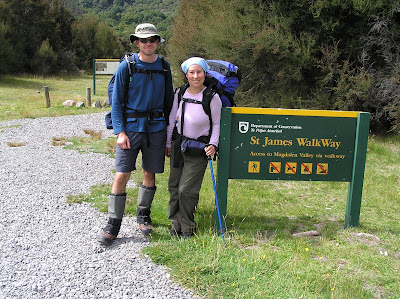
Michelle and her partner completing the St James Valley Walk Way in New Zealand

Tent: Find one with good ventilation. There is always a need to let condensation escape during the night, but if a couple is in there doing some heavy breathing, it can get steamier than usual! Also, look for a tent with two doors, so that either of you can slip out for a late-night pee without climbing over your partner and waking him or her up. Couples can often get away with a slightly smaller (and hopefully lighter) tent than other people sharing a two-person, because they don’t mind sleeping nice and close to each other. I’ve even heard of couples sharing a one-person tent, but unless you’re hard-core lightweight walkers, I wouldn’t take it to that extreme.

Backpacks: Matching sleeping bags are great, but matching backpacks are not! Most manufacturers are finally making different harnesses for men and women. The women’s harnesses are narrower in the shoulders, have straps that are shaped to allow for breasts and not squish them, and have shorter torso lengths. Some also have a more flared shape for the hip belt. It’s crucial to try on any backpack in the shop, and fill it with heavy items to test how comfortable it is. Adjust the harness and various straps to fit you, and get the salesperson to help. (If the salesperson doesn’t know how to do this, go somewhere else!) Also, get the right size for your needs. In an ideal world, it’s best to buy your packs last, so you can try packing all of your other gear into them, and return them to the shop if they aren’t big enough. (Or start deciding with gear you should return!) Generally, bigger people can carry more weight, so don’t assume you should both have the same capacity pack if you are different in size.

Good luck with your adventures!

Related topics:
Hiking Gear - the basics
Starting off Hiking? John Chapman's advice for beginners
Hiking gear - what are the basics to get started?

Continue Reading ....

Gas bottles or fuel for Tasmanian hikes? One option

Ok, picture the scenario. Sue needs gas bottles for her Overland Track hike. We know that fuel or gas cylinders cannot be taken into Tasmania by plane or on the Spirit of Tasmania. You must purchase your hiking fuel supplies in Tasmania.

Gas bottles (we use a Pocket Rocket) are usually available at the Visitor's Centre at Cradle Mountain. No stress, every time we have been there they have had boxes full BUT we decide to ring to confirm their availability (Check out the post - key to a good hiking trip is planning) -

"Nah, sorry we have run out, been on back order for a while" is the response.......

Mmm, our Hiking Blog goes into panic mode.

Gas Bottles by Orbital Joe

Sue flies into Launceston at 6:30 pm and heads off to Cradle Mountain at 7am the following day. All the outdoor stores will be closed. We are sure the Tassielink bus driver won't be keen to stop anywhere for a shopping trip.

Big problem, how to get the gas bottles she needs for her hike? Organising it from Geelong (another State away) may be a challenge.

There followed a quick phone call to Mountain Designs in Launceston with the sorry tale. Spoke to Ian, the franchisee, and requested that we pay for the cylinders by credit card over the phone and that ......would it be possible ........ to drop them off ........ where Sue would be staying? (We are talking about a $19.00 sale here, not a new tent or sleeping bag!)

No problems, says Ian, it's on my way home, happy to do it! Joy and happiness in Our Hiking Blog household. Problem solved (and gas bottle delivered as promised - Sue has them)

Now one good turn deserves another, and I asked Ian if this was part of his normal service and could put it on the Blog for others to read about and potentially contact him for help.

Ian IS HAPPY to help if people are stuck like Sue.

He can be contacted at Launceston Mountain Designs on:

Ph: 03 63340988
Fax: 03 63340977
Email: launceston@mountaindesigns.com

Just give him a bit of notice so he can arrange the delivery without the pressure we put on him......

Continue Reading ....

Yabbie Straw - Emergency water when hiking in Tasmania?

OK, first of all we thought it was a joke, but there have been several mentions of this idea around, so we thought we would post about it!

Yes, the Yabbie Straw, an "essential" piece of hiking gear many Tasmanian's carry.

What is it?
A piece of clear plastic tubing , maybe one metre long


This photo is from the Launceston Walking Club's current "Do You Know Tasmania" multimedia show. It is taken from a section covering an extended trip along the Prince of Wales Range.


What do you use it for?
If you are short of water, often there will be yabbie holes around the button grass or other vegetation in the area you are hiking. You can use the straw to suck water out of yabbie holes. This can be an excellent emergency supply of water.

Some people have been known to draw water out of shallow puddles and footprints with their yabbie straw. (saves stirring up the mud) When you are thirsty, any source of water is a bonus.

We posted a trip report by Nik on Frenchmans Cap and the Irenabys
where he mentioned using his Yabbie Straw to source cooking and washing water

The Hobart Walking Club mention a Yabbie Tube in their list of Equipment and Clothing Checklist .

There is a whole thread on the Bushwalk Tasmania forum regarding Yabbie Straws. It is a great read, and outlines the lengths walkers occasionally have to go to when sourcing water from unusual places.


Have you ever used or needed a Yabbie Straw? Share your experience via the comments section of Our Hiking Blog.

Continue Reading ....

The best hiking backpack? The One Planet Strezlecki looks the goods

Recently we posted about 5 features in a hiking backpack we do not want.

The goal was two fold:

  • an exercise to clarify what sort of pack we might purchase one day
  • to inform others of our ideas about what we define as a good hiking pack
Over the weekend we were able to visit our local Mountain Designs store. It is our city's only "pure" hiking goods store and we have been buying gear there for years. We trust the owners and staff. They are people who go hiking and climbing. They have adventures and use the gear they sell. It is like our second home where we can swap yarns about recent trips, or get advice, or borrow stuff sometimes.

We had some spare time and decided to suss out their bushwalking packs....... just to see what was around......

Now, do we really NEED a new pack each? Probably not, as these would be our third new pack in 5 years. Luckily, circumstances have fallen favourably our way and we have the CASH to splash, so purchasing is an option. (especially when we heard a rumour of a sale coming up soon)

We looked at a lot of packs. We played around with a lot of different packs. In the end we easily decided on one brand - One Planet.

In fact, we have decided on the Strezlecki from One Planet. Why you might ask?

It meets all our five criteria (and more)

1) Limited number of straps
Really simple strapping and compression system. Look at the photo. How clean and unpretentious does it look?

2) Pockets
Top, underlid and front. All very spacious, all with great zippers and wonderfully integrated into the pack design. There are also bottle holders built into the harness and some additional attachment points for extra gear. The beauty of these additional points is they are unobtrusive and streamlined. (in other words we won't cut them off to save weight!)

3) Zippers
REALLY strong #10 YKK zippers, with big handles. These zippers are tough and the sewing to hold them there solid.

4) Fabric
Strong, tough and waterproof. It is called Waterloc canvas. This is the One Planet blurb on the fabric . It is worth reading to understand the research and product development that has gone into this pack. The pack is waterproof (under most conditions)


5) Weight
Not the lightest at around 3kg but strong and durable. We want this to be the last pack we buy. We want it to last. The strength and soundness of this pack promises years of hard work and gives us confidence that it will weather anything we throw at it.


But wait.....there's more ......above and beyond the original five criteria.

Harness:
We assumed all harnesses are much the same, basically shoulder straps and a hip belt. That is until we read the harness sales pitch by One Planet where the opening line is:
We believe the harness is the most important part of a backpack. Without a strong, comfortable harness, you might as well buy a suitcase.

We now know there are about six different hip belt sizes and three different back lengths available.
As One Planet states, this creates precise control over the relationship between back length, shoulder straps and hip belt. Or, in other words, a fancy way of saying we will make it fit you, no matter what!

Service
We were a bit confused about some of the information that was available on-line and in the brochure, (we must be a bit thick here at "Our Hiking Blog" - the brochure and website are fantastic, it's just that we did not understand.....) and decided to telephone One Planet. Lee was on the phones and was, in one word, fantastic.

If her assistance was any gauge of the quality of the product and service from One Planet then I believe we are on a winner. She knew her stuff. She was the first entry to the company and had all information either in her head or online. Very impressive.
Also impressive was the length One Planet are prepared to go to custom build their packs..but that, my friends is a story for another day.

By the way, neither One Planet nor Mountain Designs have ANY commercial relationship with "Our Hiking Blog" (although they are welcome to contact us to discuss a million dollar deal!!)

Continue Reading ....

Injinji socks and toe blisters - an independant review

Injinji tetrasoks. Are the claims that toe blisters and other foot problems can be reduced by wearing them accurate? We have sourced some independant information.

Yesterday we received our samples of Injinji Outdoor Series tetrasok's as part of a deal to advertise on Our Hiking Blog. In fact, if you order them via the advertisment on "Our Hiking Blog", you will receive a 10% discount!

It put our mind to the issue of recommending a product for reward, whether it be for freebies or money. We have posted in the past that Sue tried Injinji sock with success, and in that case, she bought the socks and was extremely happy with the result i.e. no blisters!

Blisters on foot after playing soccer on a beach in Nicaragua - photo by ratterrell


Today we came across a runners forum that has a whole section on Injinji socks . We feel this is a good independant resource for any hikers out there considering trying out this product. It is not all positive, but presents a fair and alternate view from people who have used them under extreme conditions.

There is also a review (on a slightly different) Injinji sock here at Wilderness Fly Fishers, that is worth a read. Have a look around the site while you are there, good reading about "Wild Flyfishing"

Don't forget, Paul from Injinji socks, is offering a 10% discount to "Our Hiking Blog" readers when purchasing by email, so check them out, and if you order any let him know you found about them here.

The promotion code to receive the 10% discount is: Franksblog
This is the link to the Injinji website .

Related posts
Blisters? Sore Feet? These socks really work!

Blisters? Not this time. Sue tries Injinji socks with success

Continue Reading ....

5 features I don't want in a new hiking backpack

Buying a new backpack for hiking or travelling? We list five things we don't want our new pack to have as a feature.

Looking around outdoors stores for a new backpack is not our idea of fun. We need a new pack, but sorting out the hype from the reality is the challenge. This put our mind to what features we DO NOT want our new pack to have.


Photo of "Another fine day" by Extra Medium

1. Weight
We often hike for five or more days. This means we have to carry our baseline equipment (tent, sleeping bag, clothes etc) plus a lot of food. Weight is a critical issue and your pack weight is one area were it's hidden weight can add significantly to the load you must carry. Remember, your pack stays the same weight (with your base gear) from the first till last day.

We don't want a heavy pack.

2. Lots of straps and clips
We want a streamlined pack, one that is simple and uncomplicated. We don't want a strap or clip for every function ever invented by some crazy pack designer. We don't want our pack catching on every bush or branch we walk past.
Photo by extraFunky

Unnecessary straps and clips add additional weight to your pack. A good, simple compression system should be all a pack requires. You can aways use temporary straps or clips on a trip when you require them.


3. Unnecessary Pockets
Robert Howells has written a feature in GORP on How to buy a backpack , he states our ideas very clearly:

Don't be seduced into thinking a flotilla of external pockets make for a better pack than a clean, nearly pocketless design. A multitude of compartments may help you stay organized, but they add weight and complexity. They also tempt you to add weight around the perimeter of your pack, instead of inside and close to the back where it is least likely to impede movement. I prefer a simple, single front pocket, big enough to hold a rain jacket, or a hinged 'shovel pocket' for carrying wet or bulky items. Add a couple of water bottle holsters and/or a sleeve inside to hold a hydration bladder, and you have all the extraneous compartments you really need.
Could not agree more, especially when hiking in the Australia bush, where the tracks may be narrow and you want to reduce the chance of being snagged on tree branches or scrub.

4. Little zippers

We don't want cheap, weak zips on our pack. We don't want tiny handles we struggle to hold with freezing hands or while we are wearing gloves. We don't want a zip that explodes under pressure the second or third time we try and close it.

Photo by fazen

Check the zips closely before you buy. Make sure they are heavy duty with good strong teeth and a big handle or strong tag to grab in icy weather.

5. Lightweight but non durable fabric

Hiking packs have to be tough. They are stuffed full of gear and placed under pressure from the inside out. They have to carry, at times, a lot of weight. They are thrown in planes, on the ground, rained and snowed on. They must be waterproof and strong. We don't want a pack that is manufactured from lightweight and non durable material.

Strong and tough is good.

So, there are our five "Must Not Have's" when purchasing a new pack.

Feel free to add a comment with your ideas or experiences with your hiking pack. We would love to read about them.

Update!! We have decided on our favourite hiking backpack for bushwalking in Australia. Check out our post "The Best Hiking Backpack"

Continue Reading ....

Which one person hiking tent? A suggestion

Decisions, decisions, decisions.
Which one person tent should "Our Hiking Bloggers" spend their hard earned cash on?

We are in the market for a single person, lightweight hiking tent. The reason will become apparent in the next few weeks. We posted a question on the Bushwalk Tasmania forum asking Which one person tent should we buy? .

The merry band of gear junkies there came to the party and made several suggestions. mag3000 suggested the Macpac Microlight and posted a photo of his tent taken in September 02 near Solitary Mans Hut, at George Howes Lake in/near the Walls of Jerusalum National Park in Tasmania.

It's summer here in Australia and has occasionally been very hot, so seeing this photo had a very cooling effect. It is a nice bit of spring snow in Tasmania.

As mag3000 says:

"I can vouch for the Macpac Microlight , have had one for years. Mine is the Comp version, which is a little lighter that the standard. I have had no trouble with it in any weather conditions, including snow. The advantage with the tent so small you can push the tent walls out without getting out of your sleeping bag."

We have heard of Solitary Man's Hut but have never been there. A quick search turned up a report from the Warrnambool Walkers regarding a day trip into the area.

This is an edited version of the report:
The history of Solitary Man’s Hut.
A soldier returned from the Vietnam War, unable to face society. He headed for the wilderness to settle out there by Tiger Lake. He built a simple shelter, an A-shaped hut with a fireplace, a bed with a mattress of animal skins and neatly hung essential utensils for daily living. Outside, a large flat boulder served as a platform for his exercises.He would walk and ride a bike that was stashed in the forest down the mountains, to Mole Creek for his rations. He lived in the hut for some years. These days he has settled in Launceston with a family of his own. He returns to the hut sometimes. The door is left unlocked for day walkers and as an emergency shelter.
The track to Trappers Hut is well-marked and well-known. The track then heads east through alpine scrub. Wearing long sleeves for shade on a nice fine day, prickly scoparia scratched our legs. Tiger Lake is about 90 minutes beyond Trappers Hut. Pencil Pines reflect in the dark waters of the lake. Giant mosquitoes are resident. Ken encountered his first leech.We picnicked with the mozzies. We retraced our steps, passing George Howes Lake and many tarns. When the dolerite rocks of Clumner Bluff towered like a fortress we were at the end of our day of walking in a beautiful isolated area near the Walls of Jerusalem.

Continue Reading ....

Blisters? - Not this time, Sue tries Injinji hiking socks with success

Blisters, hot spots and sore feet, Sue's hiking curse!

Ever since we have been hiking together Sue's feet have caused her problems. She has an odd shaped little toe that curls under her fourth toe and she always gets blistering and severe pain. Following one long walk, the skin on one little toe "de-gloved" to her dismay, and it took several weeks to heal. She has tried many solutions to prevent this problem including visiting a podiatrist, taping, padding, vaseline and bandaids. She has also replaced her boots twice to see if different styles might help. These have been successful to varying degrees but can be time consuming and , unless she was vigilant, she often received blisters anyway.


Franks's feet at the end of a recent hike - blisters, dirt and tape


One Sunday she was reading "Great Walks Magazine" magazine and saw an ad for Injinji socks that make the claim of reducing blistering and sore feet for not only hiking but runners, athletes and other sports people.


The blurb on the website describes the Outdoor Series tetratsok :

as an interface system specifically designed to perform and adapt to any type of terrain. Engineered with AIS:technology and constructed with Injinji’s exclusive natural wicking Nüwool™, the tetratsok provides exceptional comfort and performance unlike any other athletic wool sock.

She immediately tracked down Paul, the Australian Injinji guru by phone , and subsequently ordered a pair by email . They arrived in time for our November trip into the Walls of Jerusalem. The socks are quite a wierd configuration, more like toe gloves than socks.

They were invented by two brothers in the US. Again, from the website:

In 1999, the Romay brothers set out to redesign the basic structure and shape of the regular sock. Their intentions were pure and simple: “We wanted to create the best possible interface that allowed the entire foot to perform naturally and freely inside our shoes, just like being barefoot. There had to be a way to combine the comfort and dexterity of bare feet with the protection of a seamless sock. Everything about the conventional tube sock works against your feet’s natural form and function.”
Consider the difference between gloves and mittens: Mittens keep your fingers together to create a warmer, oven-like environment, while gloves offer less warmth but more dexterity. The same principles can be applied to our feet. Conventional socks force your toes to work together as one unit, creating unprotected friction, heat and moisture build up, and constricting the circulation of the foot. Have we been wearing mittens on our feet all this time?


So, what was the result? Excellent according to Sue. No blisters. No taping or padding. Just the tetratsok's and her normal boots! A VERY satisfied customer.

These wierd looking injinji tetratsok's on Sue's feet after walking from the carpark up to Wild Dog Creek platforms.

With an incredible coincidence we met some other hikers from Queensland on that same walk. Howard and Jo BOTH wear injinji socks!! They have been using them for a while and were very happy with them. Pictured below are Howard's feet in the socks. Howard reckons they are great, and have saved his feet from blisters and soreness on many occasions.

Howard's feet resting at Wild Dog Creek just outside the Walls of Jerusalem.

So two positive testimonials on the same socks, they sound like a winner to us!

Paul, from Injinji socks ,is offering a 10% discount to "Our Hiking Blog" readers when purchasing by email, so check them out, and if you order any use the promotion code "Franksblog" to receive the discount

Paul was also kind enough to agree to advertise on "Our Hiking Blog" so, as much as we love the socks, we are also received a small donation for the advertisement.

Related Posts
Injinji Socks and blisters - an Independant review
Blisters? Sore feet? These socks really work!


Continue Reading ....

Ultralight D-Ring for your pack

Sometime the simplest ideas are the best and this idea is the ultimate in simplicity.

Discovered an excellent boutique blog, Gear Talk and web site Home made backpacking gear today. They have been created by Jason Klass, from Denver, Colorado and the focus is on homemade ultralightweight hiking gear. There are several excellent examples of innovative design that Jason has either created himself or sourced from other "mad" inventors.

The first one that appealed to us was the simplest design we have ever seen. That is for an ultra light D-Ring. Click on the link and check out this great idea for hanging gear off your pack, guiding an hydration hose or replacing existing D-Rings with a lighter version.

The D-Ring, fitted to a pack. Weight? almost zero.

Jason has also made a movie of how to create the D-Ring on YouTube. He has several other terrific instructional video's that are well worth a look.

Continue Reading ....

Light weight camping? I think not - Our Hiking Blog goes camping

Lightweight hiking is a goal for all, but when it comes to a summer camping trip all rational thought goes out the window. We head off early tomorrow on our annual camping holiday to Blanket Bay, in the Otway National Park.

Blanket Bay is a small National Park camping ground near Cape Otway Lighthouse in southern Victoria. There are only 20 odd sites with no power, a small amount of water and long drop dunnies. No generators are allowed. We have been going there on and off for over 30 years.

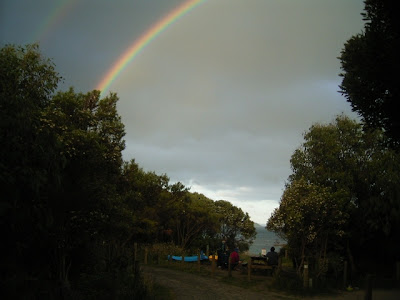
A double rainbow at Blanket Bay

The great 24 hour packing exercise is about to begin and it got us thinking about the differences in gear we take for a fixed camping trip compared to a hiking trip. They are, in our case , HUGE.
The comparison may be interesting for "Our Hiking Blog" readers

Bedding
Blanket Bay: a queen sized self inflating mattress, underblanket, sheet and a doona. Two pillows each
Hiking: Down sleeping bag and a 3/4 length thermarest mat each

Refrigeration
Blanket Bay: Two gas powered fridges, a Coleman 40 litre esky and another small esky
Hiking: nothing

Food and drinks
Blanket Bay: about four large boxes of food ranging from dips and chips to bacon and eggs. Several bottles of champagne, red & white wine, beer, spirits etc
Hiking: just enough food for each day, packaged carefully to avoid carrying extra weight. Some sachels of "tang" as a treat with water

Clothing
Blanket Bay: a large overnight bag each, 3-4 different pairs of footware, 2-3 towels each
Hiking: What we are wearing plus a few spares and cold/wet weather gear

Furniture
Blanket Bay: fold out chair each, tressle tables (two), coffee table, fold out tables (two)
Hiking: nothing

Reading material
Blanket Bay: about 6-8 books each, various magazines
Hiking: one book, selected for size and weight

Other junk
Blanket Bay: snorkling gear, wet suits, fishing gear, games, dish rack, washing up tub
Hiking: essentials, pocket knife, quick dry towel (maybe), first aid kit

Lighting
Blanket Bay: Coleman Lantern, headlight each, 12v fluro, 12v battery pack, candles
Hiking: headlight each

Transport
Blanket Bay: Our twin cabin utility with roof racks loaded, the back full and a hire trailer.
Hiking: The pack on our back and our legs.....simplicity.

Continue Reading ....

Hiking books and gear from Amazon - launching "Our Hiking Blog" store

We love retail therapy at "Our Hiking Blog", especially when it relates to new hiking gear or "must have" toys that will make our trips more comfortable. Unfortunately we have most of the gear we need so often we can only browse in outdoors shops or look online for gear

Photo by babasteve, reproduced under Creative Commons


We recently discovered that Amazon not only has a huge range of excellent outdoors books, but also every bit of gear we may have dreamed about adding to our collection. In addition, you can create your own tailered eStore. So over the Christmas break we have created the "Our Hiking Blog" Amazon Store. Check it out, even if you are just dreaming.

Continue Reading ....

8 tips to make a good hiking trip, great

How can you make a multi day hiking trip great?

What's the best preparation before you leave on your next bushwalking trip?

What are eight key ideas that will elevate your trip to "one of the best"?

Reducing risk on your next trek, some ideas.

We have put together our "Top 8" list of ideas we always use whenever we head out into the bush on any length hiking trip.


Photo by Garrulus

Now the list, in no particular order........

1) Good food
Spend some time to plan your meals so you have some great food to look forward to at the end of each day. There are many light weight options and our posts on food may be helpful.

Nothing beats a yummy meal at the end of a great day's hiking. A little preparation can produce great hiking meals you will remember for years.

Great food, great trip

2) Good companion(s)
Whether there are only two of you, or a larger group, we think who you hike with is vital.
Having a shared vision for the hike makes for reduced tension and great fun together as a couple or group.

For example, we have a mate who enjoys the physical challenge of hiking and loves covering huge distances in one day. He enjoys arriving at camp, stuffed. Others we walk with enjoy the stroll, stop and look at flowers, or the view, and take lots of photo's. They both want to experience the environment in different ways.

Understand what each member of the party wants to get out of the trip before you leave and tailor it to keep everyone happy.

3) Know your route and expected hiking times
Research, research, research.

If you are heading out somewhere new, someone (or two) in the group must take the time to research the walk, purchase (and remember to bring) the maps and load the waypoints into a GPS if one is being used.

Remember, often distance is irrelevent compared with travel time. For example, there are sections in many Tasmanian walks that are shortish distances (say 10km) but it might take 5 hours or more to cover.

Make sure the walk is planned for the slowest member in the group to arrive at camp in daylight!

4) Light weight
We are mid weight hikers.Our gear is nowhere near light weight but we have pruned it to the bare essentials over the years. Make sure you do the same.

Every gram you remove in base gear (stuff you carry the whole trip) is a gram less on your back and hammering your feet as you walk.

Look at removing spare clothing, food packaging and fuel to save weight. Get rid of all the junk that looked so appealing in the Outdoors shop like disinfectant hand gel and a foldup washing up bowl.

Improvise, lose weight, go light and enjoy.

5) Comfortable footwear
Frank is on his third pair of boots in 5 years and still not happy but getting there.

Make sure your footwear is well broken in and comfortable before your head out. Just breaking them in on footpaths walking around your neighbourhood is not good enough. Try them with a loaded pack a few times, on rough ground, before you go.

The pressure points and stresses are certainly different. It is time well spent.

Comfortable boots, comfortable trip


6) Let someone know where you are going and when you will be back

This suggestion may not improve your trip, but is sensible and could get you out of trouble if something goes wrong. Leave accurate information with a RELIABLE adult about where you plan to go, and when you plan to return.

Bushwalking Victoria have a good site with an excellent bushwalking safety tips document called Walksafe.
John Chapman also has some good additional information on hiking safety, which is well worth reading.

Letting someone know where you are going, might help you get back

7) Take shared gear
Take some time to organise sharing some gear before you leave.

Ask yourself the question, do we all need to carry suncreen, bug repellant and a Swiss Army knife?

Rationalise your gear.

You only need one of each item for the whole party on most trips. Think weight saving and hence comfort, as you have to carry this additional weight the whole trip. Having a checklist of the usual gear you take is useful. Print out copies of the list and agree who takes what.

Lightweight trips are great trips, share your gear

8) Pick somewhere fantastic to hike

Location, location , location.

There are some spectacular hiking tracks near all of us. Research by looking on the Web, contacting the Parks Offices near you or joining a local hiking club.

Forums are also a terrific way to learn about wonderful trips that can be from one to 100 days.

Pick a great spot to hike, your spare time is worth you making the effort to find the best!

Related Posts
Planning food for a 9 day hike
Hiking gear - what are the basics to get started?
Best clothes for a multi day hike - the layering system explained

Please don't hesitate to comment with your ideas. We are sure there will be MANY ideas that help make your hiking trip GREAT.

Continue Reading ....